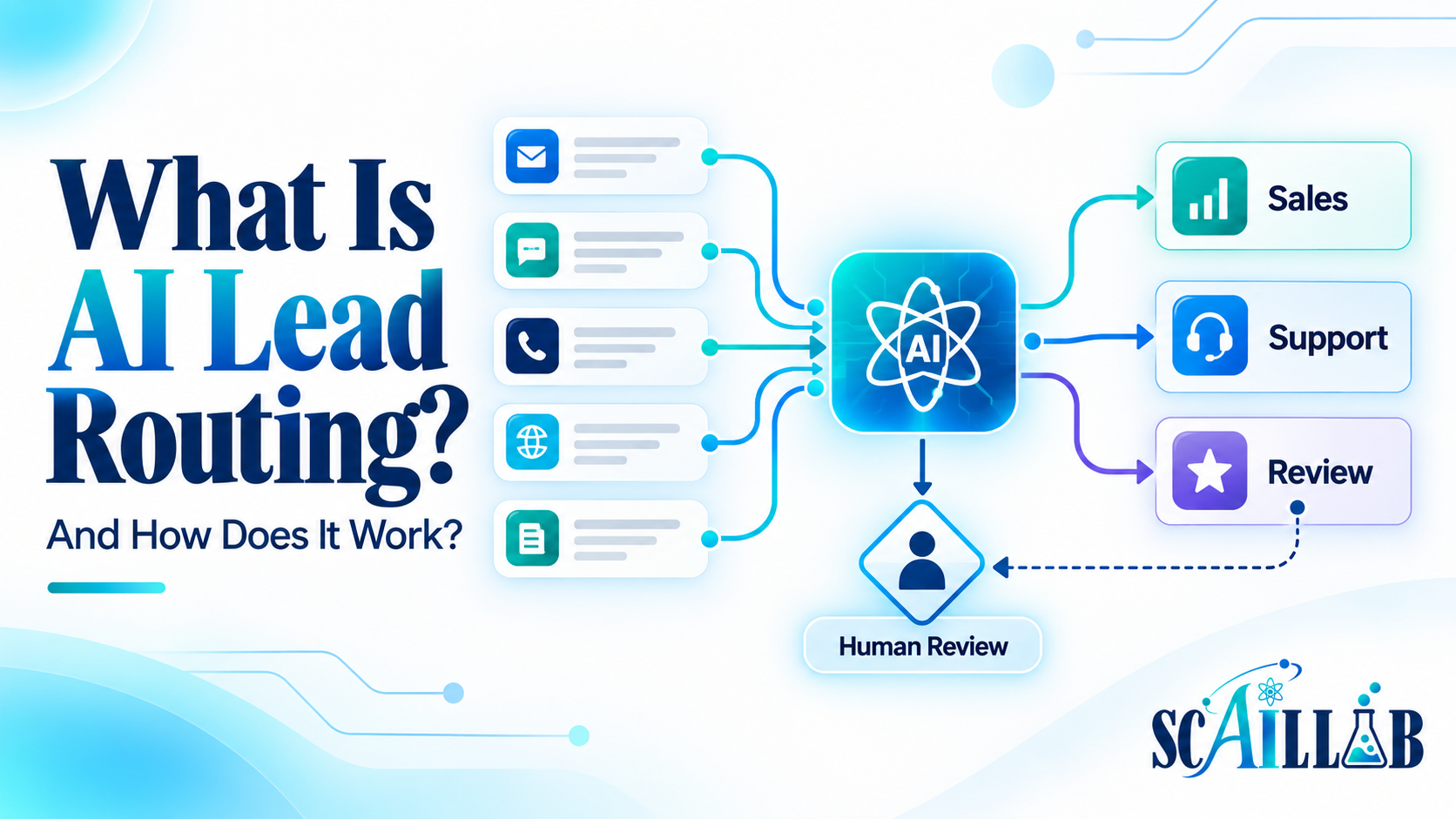
When a new inquiry arrives, someone usually must answer several questions: What is this person asking for? How urgent is it? Who should handle it? Is the information complete? Does it belong in a particular workflow?
In many businesses, those decisions are made manually for every inquiry. That may work when volume is low, but it can become inconsistent as requests increase.
An AI lead router helps organize that first stage of the process. It reviews incoming information, identifies patterns, and recommends or initiates the next step according to defined business rules.
What does an AI lead router do?
An AI lead router analyzes information from a new inquiry and helps determine where it should go.
Depending on how it is designed, the workflow may:
- Read information from a website form or email
- Identify the type of request
- Classify the inquiry by service or category
- Estimate urgency
- Check whether required information is present
- Assign the inquiry to a person or team
- Save the record in a spreadsheet, CRM, or other system
- Send an acknowledgment
- Flag the inquiry for human review
- Log the decision and next action
For example, a form submission might describe a request for technical support, a project estimate, or general information. The router can classify the request and send it to the appropriate workflow or team member.
The purpose is not to let AI make every decision independently. The purpose is to reduce repetitive sorting and make the next action more obvious.
How is this different from rules-based automation?
Traditional automation follows rules that have been defined in advance. For example:
- If the form includes “billing,” send it to accounting
- If the subject contains “appointment,” create a scheduling task
- If the sender matches a known customer, add the message to the customer record
Rules-based automation works well when the information is predictable and the categories are clear.
AI can help when the same request may be expressed in different ways. A person might write “I need help connecting our systems,” “Our software doesn’t communicate,” or “We’re entering the same information in three places.” AI may recognize that these inquiries relate to a similar type of business-systems problem even though they do not use the same words.
In practice, the strongest workflows often combine both approaches. Rules provide structure and boundaries, while AI helps interpret less predictable language.
Where should human review remain?
AI lead routing should not eliminate human responsibility.
A request should be sent for review when:
- Required information is missing
- The classification is uncertain
- The inquiry appears urgent
- The request involves sensitive information
- The inquiry does not match an existing category
- A duplicate record may already exist
- The request falls outside established business rules
Human review is especially important when the consequences of a wrong decision are significant. A person may need to clarify the request, determine the right response, or decide whether the inquiry is appropriate for the business.
The guiding principle is simple: automate repetition, preserve judgment, and design for exceptions.
What information does an AI lead router need?
The quality of the routing depends on the quality of the information and instructions behind it.
Before building a router, define:
- The categories or services you want to recognize
- The information required for each category
- What qualifies as urgent
- Which person or team owns each type of request
- Which situations require human review
- Where the lead record should be stored
- What acknowledgment should be sent
- How duplicate inquiries should be handled
The AI should also receive clear instructions about what it should not assume. If the information is incomplete, the workflow should flag the uncertainty rather than fill in details without support.
How do you know if routing is working?
An AI lead router should be tested and measured like any other business process.
Useful measures may include:
- Routing accuracy
- Time from inquiry to assignment
- Percentage of inquiries with a clear owner
- Number of inquiries sent for review
- Number of incorrect classifications
- Duplicate inquiry rate
- Follow-up completion
- Exception rate
- Failed or stalled workflow runs
Testing should include more than a few ideal examples. Use inquiries with different wording, incomplete information, multiple needs, unusual requests, and possible duplicates.
A reliable system should not allow exceptions to disappear silently. It should show what happened, where the inquiry went, and whether someone needs to take action.
Is an AI lead router right for every business?
Not necessarily.
If a business receives very few inquiries or has a simple process, a basic form notification may be enough. AI becomes more useful when inquiries vary in content, several people or teams may need to respond, or manual sorting creates delays and confusion.
The right starting point is a workflow review. Understand how inquiries currently arrive, where they wait, who handles them, and what information is repeatedly interpreted or entered.
Then determine whether a rules-based workflow, AI assistance, or a combination of both is appropriate.
Need a clearer path for incoming leads?
Scail Lab helps businesses design practical lead-routing and follow-up systems around their existing processes. Services include workflow audits, automation design, AI-assisted operations, systems integration, documentation, and training.
Based in the St. Louis Metro East, Scail Lab provides onsite consulting for local businesses and remote services for clients beyond the area.
Contact Scail Lab